Unless you live in a large uptown cave (you know, the kind that defaces a hillside to park a Mercedes), then you’ve heard of Shebada—the slim-built, hair-dyed dynamo of roots theatre. No? Here’s your primer.
Roots theatre, the long-suffering bastard child of West African storytelling and English farce, has finally come of age. And its adulthood is being ushered by one company. Over the last few years, Stages Productions has used administrative and marketing savvy to turn their handful of contract players into highly profitable household names. Shebada and his peers work six nights a week and twice on Sundays, playing to full houses at Green Gables Theatre, as well as auditoriums, hotels and schools around the island, all at $1200 a head.
Given such compelling math, the literature doesn’t get much attention. Stages plays are, at worst, thematically disjointed, sexually gratuitous, visually monotonous and overlong—symptoms of poor writing and direction. But in Ghett Out, Shebada’s latest romp, the peculiar alchemy of script and improvisation, of audience and performer, and of comedy and commentary is one step closer to gold.
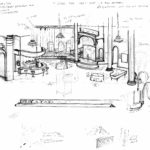
Written by Michael Denton, directed by B L Allen, Ghett Out takes place in a bullet-prone ghetto lane (you know, the kind that you’d be afraid to park a Mercedes), home to three tenants—illegal vendors Shebada and Barbara (Maylynne Lowe), and fallen Maude (Abigail Grant), who used to have a house, a car and a husband. Her plight provides just enough story for us to enjoy the extended comic routines.
In Ghett Out, a coherent story makes for a richer poor-man’s tale
And what joy it is (if you can sit for three hours on a metal chair). The Stages brand of theatre, at best, echoes vaudeville of a century ago, with its flat sets, broad types, dirty jokes and open invitation for audience participation. Luke Ellington and Maxwell Grant play policemen Macka and Run Tings, handling hijinks and managing malapropisms with true bumbling perfection. Ellington is the Abbott to Grant’s Costello, and like any comic duo they are at their best when misunderstanding one another.
The rest of the Ghett Out cast is serviceable—Abigail Grant, Junior Williams and Orville Hall stand up without standing out. Maylynne Lowe is the latest high-profile crossover from the New Kingston theatre circuit, no doubt drawn by the fat paycheck. Hers is the misfortune of being Powell in the age of Bolt; there’s room for only one lithe, histrionic diva on the Stages stage.
So we arrive where we started—Shebada.
If most of the company’s success can be attributed to business acumen, the remainder must go to the talent of their stars, especially one Keith Ramsey. Pop sociologist Malcolm Gladwell (incidentally, Jamaican-born) says the difference between mediocrity and genius in any field is 10,000 hours of practice. As Shebada, Ramsey is racking up the hours, and all that practice has made him very funny.
One of the hardest skills for an actor to master is the spontaneous reaction; Ramsey does it effortlessly, creating on-the-fly responses to heckling patrons while keeping one ear in the scene. Though young, his experience as a comedian shows in his intuitive knowledge of what the audience sees. The night the Gleaner attended Ghett Out, a patron made fun of Ramsey’s get-up as he crossed the stage. Ramsey paused, without looking at either his clothes or the heckler. He simply stood there, to the roaring delight of the crowd, and then resumed his movement. Whatever Stages is paying him, they should double it.
The true genius of Ghett Out, and by extension the entire Stages enterprise, however, is the way it taps into our collective psyche. Sure, a philandering husband is comedy, but in a country with so many single mothers, it’s also a tragedy. Sure, a trigger-happy officer is funny, but in a time when our real policemen kill in cold blood, it’s also cathartic. We don’t just want to laugh; we need to laugh. In this way, Stages is almost providing a public service, a sort of ritual confessional where we can purge our sins and then take a route taxi home.
The play’s title draws from our de facto national motto, put simply by Run Tings—take what you can, and get out. Roots theatre is more profitable than ever; by some back-of-the-envelope math, Stages pulls in a cool $1,000,000 each week. As the audience got out of Ghett Out, turning into citizens once more, they had to pass the black Mercedes parked by the door. Here’s hoping Stages helps us climb our mountain, instead of defacing yet another hillside.